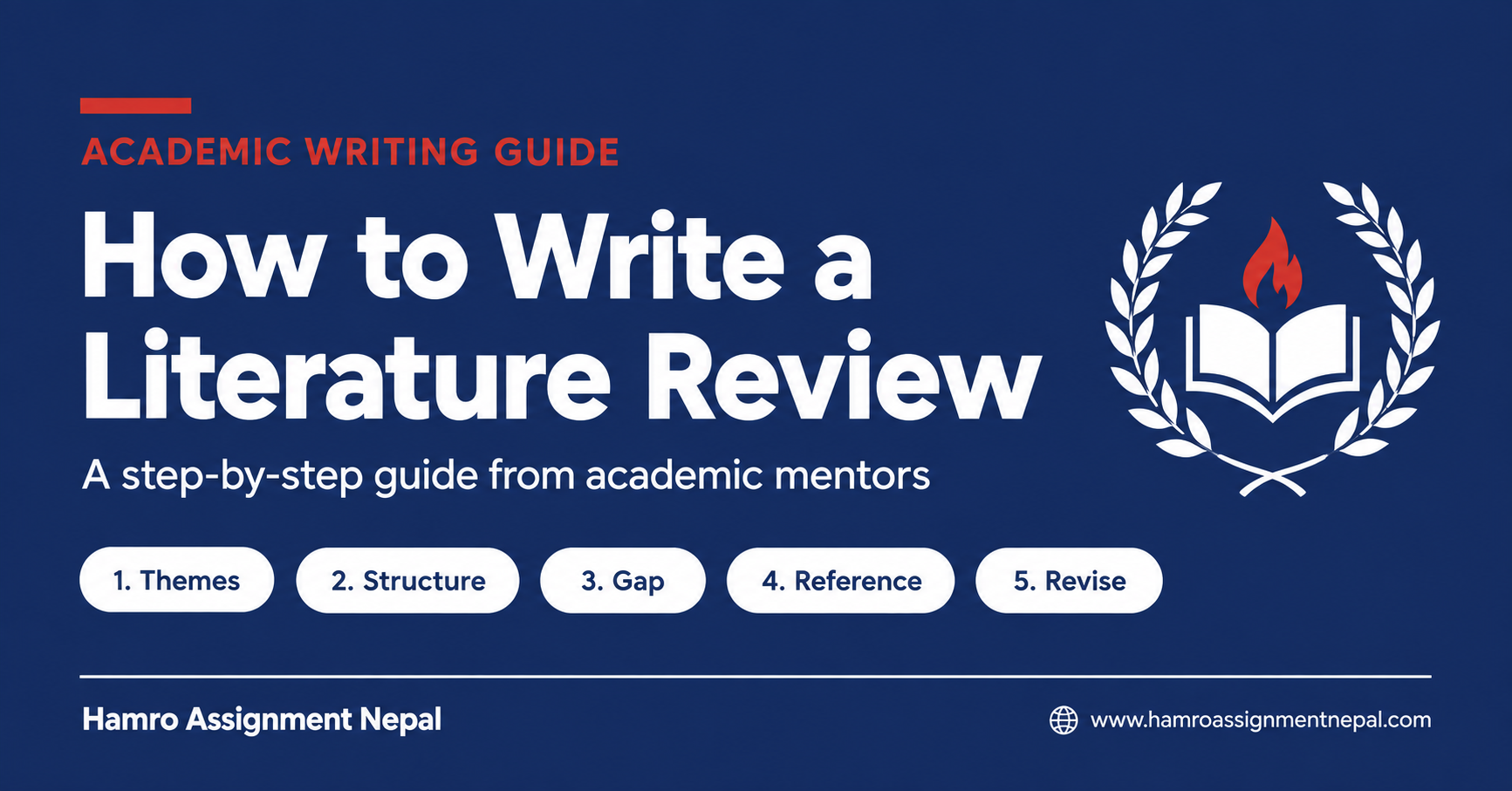
How to Write a Literature Review: A Step-by-Step Guide for University Students
If you've stared at a blank document wondering how to turn twenty research papers into a coherent literature review, you're not alone. It's one of the sections students in Nepal and abroad struggle with most, not because the research is hard to find, but because organizing it into an argument is a different skill entirely.
This guide walks through the process our academic mentors use with students, from IT and business degrees to master's-level dissertations.
What a Literature Review Actually Does
A literature review isn't a list of summaries. Its job is to show three things: what researchers already know about your topic, where they disagree, and what gap your own research fills. Examiners can tell within a paragraph whether a student has summarized sources or synthesized them, and that difference alone often separates a 50 from a 70.
Step 1: Organize Sources by Theme, Not by Author
The most common mistake is writing one paragraph per source: "Smith (2020) found X. Then Jones (2021) argued Y." This reads as a list, not an argument.
Instead, group your sources around themes or debates in your field. For example, if you're researching digital adoption among small businesses, your themes might be:
- Barriers to adoption (cost, skills, infrastructure)
- Drivers of adoption (competition, customer demand)
- Measured outcomes (revenue, efficiency)
Within each theme, discuss what multiple sources say together, where they agree, and where they conflict.
Step 2: Build the Three-Part Structure
A strong literature review paragraph typically does three things in sequence:
- State the claim, supported by sources: "Digital adoption has been linked to measurable revenue growth in SMEs (Author, 2023; Author, 2024)."
- Add nuance or disagreement: "However, this effect appears strongest in retail and weaker in manufacturing (Author, 2022)."
- Connect it to your research: "This inconsistency suggests sector-specific factors remain underexplored, which this study addresses."
Repeating this pattern across themes turns a list of citations into a genuine argument.
Step 3: Identify Your Research Gap
Every literature review should end by pointing at what's missing; that gap is what justifies your own research. Ask:
- What questions have researchers not yet answered?
- What context (country, industry, population) hasn't been studied?
- What methods haven't been tried?
Write this explicitly: "While prior studies have examined X in Y context, few have explored Z, which this study investigates."
Step 4: Reference Correctly and Consistently
Referencing errors are one of the fastest ways to lose marks, especially in Harvard and APA styles common in UK-affiliated programs. A few rules worth double-checking:
- Match your in-text citation style to your reference list style exactly.
- Cite every claim that isn't common knowledge, even when paraphrasing.
- Keep your reference list alphabetized and formatted consistently, including punctuation and italics.
Step 5: Revise for Flow, Not Just Grammar
Once the content is in place, read the review as a reader would. Do the themes flow logically into one another? Does each paragraph build toward your research gap, or could sections be reordered without losing meaning? This is usually the stage where a second pair of eyes, a mentor, supervisor, or peer, catches structural issues you can't see after staring at the same draft for hours.
Common Questions
How long should a literature review be? It depends on your program and level, typically 15–30% of a dissertation's total word count. Check your program handbook for the exact expectation.
Can I use AI tools to help? AI tools can help you summarize sources or check grammar, but the synthesis and argument need to be your own. Most universities have specific policies on AI use in coursework and research; check yours before relying on one.
What if my sources disagree with each other? That's not a problem to hide, it's often the most interesting part of a literature review. Disagreement between sources is exactly what points toward a research gap.
Getting Feedback on Your Draft
A literature review is easiest to strengthen with feedback from someone who can point out where the argument thins out or the structure loses its thread. If you'd like a mentor to review your draft and talk through your research gap, book a free 15-minute consultation or message us on WhatsApp.